Born Ehrich Weiss, Harry Houdini had built a global reputation as an escape artist.
Before reaching Britain, he toured America’s vaudeville circuit and dime museums, where his handcuff escapes attracted major theatrical managers.
His arrival in Europe turned him from a struggling illusionist into an international star who commanded huge fees and devoted crowds.
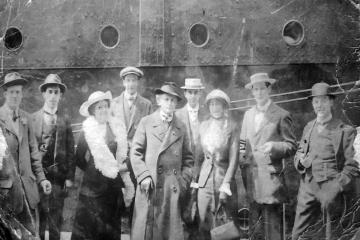
Harry Houdini in Southampton with members of Associated Wizards of the South. (Image: Archive)
By the summer of 1909, Houdini was a worldwide sensation, famed for escaping seemingly impossible restraints.
Southampton was about to witness a very different kind of spectacle.
The streets were often filled with theatregoers watching touring variety acts, moving pictures and music-hall stars.
For Houdini, Southampton offered a high-profile stage and crowds of residents and passing travellers.
Local newspapers of the time carried a Hippodrome advert for his shows.
But Houdini’s 1909 visit was not confined to the Hippodrome stage.
Harry Houdini (Image: Archive)
The Daily Echo advertised a daring dive in which Houdini would leap from the Western Esplanade into the sea, heavily manacled, chained and locked.
The esplanade, developed in the 1890s to improve the coastal road, gave thousands of spectators a clear view.
Houdini arrived at the esplanade on August 26 to perform the manacled dive.
The Daily Echo reported his manacled dive into Southampton Water, and the stunt proved a talking point as local newspapers reviewed the week’s events.
After the Southampton stunt, Houdini toured Europe, bought a Voisin biplane and set his sights on Australia as an aviation pioneer.
But Houdini eventually found the call back to Southampton too tempting – he returned to the town’s Hippodrome in spring 1911.
The Hippodrome Theatre in West Marlands Road, Southampton. 1907. (Image: Echo)
The Hippodrome, built behind the old Boot and Star public house, remained a leading venue for variety acts.
Local newspapers again carried prominent adverts for his shows.
The 1911 visit also brought Houdini into contact with Hampshire’s magical community.
During his time in the town, Houdini met the Associated Wizards of the South and was inducted as a member.
A private confrontation was later alleged to have taken place during the meetings.
The society’s chairman, Professor Woodley, reportedly challenged Houdini to a game of contact mind-reading that left him stumped.
Harry Houdini (Image: Archive)
Despite the reported setback, Houdini continued to try new material on the Hippodrome stage.
Local papers reported that Houdini was performing a one-act playlet at the Hippodrome called ‘Challenged or Houdini Upside Down’.
The play let Houdini perform escapes while acting in a drama, helping him avoid performance restrictions and protect his methods from imitators.
It showed how seriously Houdini took protecting his act from imitators.
Most physical traces of Houdini’s visits have disappeared through redevelopment and wartime destruction.
German bombs destroyed the Hippodrome during the Blitz in November 1940; its Moorish façade survived briefly before also disappearing.
The Western Esplanade was later altered by land reclamation and the construction of facilities including the National Express coach station.
His performances offered a break from dockyard work and the tensions of the pre-war years.
From his meeting with the Associated Wizards of the South to his plunge into Southampton Water, Houdini’s Hampshire appearances remain part of the region’s theatrical history.
Modern pavements around Castle Way and the waterfront now cover places where Houdini once performed.
